
National Science and Technology Council-backed National Central University built color router, overcoming limits
2025.04.22
Article quoted from:國科會支持下中央大學開發高效色彩路由器+突破彩色影像感測技術瓶頸
| Commercial Times Lu Junyi
With support from the National Science and Technology Council, the research team led by Professor Wang Zhiming from the Department of Optics and Photonics at National Central University, together with its spin-off startup MetaRosetta, has successfully broken through the limitations of color image sensing technology. The team utilized a mature 0.18 μm semiconductor lithography process, combined with self-developed electromagnetic simulation and AI optimization technologies, to develop a high-efficiency color router with optical efficiency exceeding 120%.
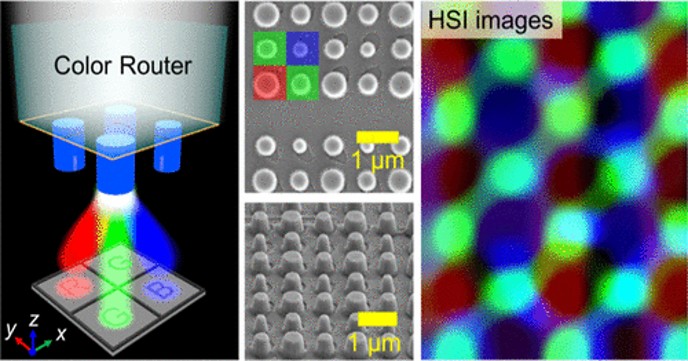
A key breakthrough in next-generation imaging sensor technology
This technology represents an innovative breakthrough for next-generation high-resolution image sensors and can be widely applied in everyday devices such as smartphones, high-end cameras, autonomous vehicle imaging sensors, as well as medical diagnostic equipment and AR/VR devices. The research team at National Central University stated that this technology not only reduces manufacturing costs but is also expected to significantly improve sensing performance at submicron pixel scales, providing a new solution for future high-resolution image sensors.
Technical challenges brought by pixel miniaturization
Color image sensors are core components of modern imaging technology. As market demand for high-resolution imaging continues to grow, individual pixel sizes have shrunk from 1.6 micrometers to 0.8 micrometers and are advancing toward next-generation 0.56 micrometer technology. However, as pixel sizes continue to shrink, the energy flux entering a single pixel through color filters drops significantly. At submicron scales, diffraction effects become more pronounced, gradually reducing the optical focusing efficiency of traditional wafer-level refractive microlenses.
A new solution enabled by high-efficiency color routers
To address these technical bottlenecks, “color router” technology capable of precisely directing color signals to adjacent pixels has emerged. However, most existing color router technologies rely on advanced processes below 65 nm, resulting in high costs and significant manufacturing challenges.
The research team noted that by integrating high-efficiency color routers, even under extremely small pixel conditions, it is possible to obtain images with accurate colors and rich details, further improving image quality and machine vision accuracy, while advancing imaging sensor technology toward higher resolution and lower power consumption. The research results have been published in the international top journal ACS Photonics and selected as a supplementary cover of the journal.